End-to-end encryption, zero-knowledge architecture, and why most "cloud journals" are not as private as they claim.
Category: Privacy & Security · 8 min read
Discover how AI mood tracking, smart tagging, and monthly summaries turn scattered thoughts into meaningful self-knowledge.
Category: AI-Powered Reflection · 7 min read
Practical, research-backed techniques to start journaling and stick with it — plus how MindsKeep makes consistency effortless.
Category: Journaling Tips · 6 min read
The difference between processing pain and rehearsing it — and a simple 4-step prompt to keep your journal safe.
Category: Mental Wellness · 6 min read
How a simple 0–10 daily log gives your psychiatrist real data to work with — and what to track (and what to leave out).
Category: Journaling Tips · 5 min read
The "write every day" rule is the fastest way to kill a habit. One sentence is enough.
Category: Journaling Tips · 5 min read
How to Choose a Truly Secure Journal App: MindsKeep's Zero-Knowledge Advantage
Keywords: secure journal app, encrypted diary, zero-knowledge proof, privacy-protected journaling, end-to-end encryption
Bottom line: If your journaling app can read your entries, so can hackers, employees, and government subpoenas. MindsKeep uses client-side AES-256 encryption — we physically cannot read your data.
Why Your Diary Needs Real Security
A personal journal is one of the most intimate forms of self-expression. It contains raw emotions, private fears, ambitious goals, and sensitive memories. Yet most popular journaling apps store your entries as plain text in the cloud, protected only by a terms-of-service promise.
That is not enough. Data breaches at major tech companies happen constantly. A truly secure journal app must treat your thoughts with the same cryptographic rigor as a banking app.
Core Privacy Concepts Every Journal User Should Know
- End-to-End Encryption (E2EE): Your data is encrypted on your device before it ever leaves. Only you hold the decryption key.
- Zero-Knowledge Architecture: The service provider has zero knowledge of your data's contents. They cannot read, analyze, or sell your thoughts — even if they wanted to.
- Client-Side Encryption: Encryption happens locally in your browser or app. The server only sees ciphertext.
- Data Sovereignty: You choose where your data lives — local-only or encrypted cloud. You retain full ownership.
How MindsKeep Implements Extreme Privacy
MindsKeep is built on a zero-knowledge proof architecture. Here is what that means in practice:
- AES-256 Encryption: Every journal entry is encrypted using the industry-standard AES-256-GCM cipher before syncing.
- Password-Derived Keys: Your encryption key is derived from your password via PBKDF2 with 100,000 iterations. We never store your plaintext password.
- Envelope Encryption: A unique Data Encryption Key (DEK) wraps all your entries. Changing your password only re-wraps the DEK — no need to re-encrypt years of memories.
- No Backdoors: We have no master key. If you lose your password, we cannot recover your data. That is the trade-off of real privacy.
Comparing MindsKeep to Mainstream Alternatives
Many well-known diary apps encrypt data "at rest" on their servers — but they control the keys. That means their employees, hackers who breach their infrastructure, or legal authorities with a warrant can access your entries. MindsKeep eliminates this risk by ensuring the keys never leave your device.
Learn more about how AI can enhance your self-reflection while keeping your data private.
Why Choose MindsKeep?
Beyond encryption, MindsKeep offers a pure, distraction-free writing environment. No ads. No social feeds. No data mining. Just you and your thoughts — protected by cryptography you can verify.
Ready to journal with real peace of mind?
Start Your Private Journal on MindsKeep
How AI Helps You Understand Yourself: MindsKeep's Gemini Insights
Keywords: AI journal, self-reflection, mood tracking, Gemini journaling, AI-assisted writing
Bottom line: AI does not replace introspection — it magnifies it. MindsKeep uses Google Gemini to surface patterns in your thinking that would take months of manual review to discover.
The Limitations of Traditional Journaling
Writing daily is powerful. But human memory is flawed. We forget details, misremember emotional intensity, and struggle to connect themes across hundreds of entries. Manual review is time-consuming and often biased by our current mood.
An AI journal assistant solves this by offering objective, large-scale pattern recognition while keeping your data private.
MindsKeep's Gemini-Powered Features
- Monthly AI Summaries: Gemini reads your entries for the month and generates a cohesive overview — key themes, emotional trends, accomplishments, and challenges. You get the forest, not just the trees.
- Smart Tagging: The AI automatically suggests up to 5 relevant tags per entry (e.g., "Productivity", "Anxiety", "Family"), making retrieval effortless.
- Mood Summaries: Each entry gets a one-sentence emotional snapshot, helping you track how your feelings evolve over time.
- Language-Aware: Whether you write in English, Chinese, Spanish, or Norwegian, Gemini responds in the same language.
Privacy-First AI: How It Works
A common concern with AI-assisted writing is privacy. MindsKeep addresses this head-on:
- Opt-In Only: AI features are completely off by default. They only run when you explicitly click "Analyze Entry" or "Generate Monthly Summary". Simply writing and saving does not trigger any AI processing — and costs zero tokens.
- No API Key Required: You do not need to configure anything. MindsKeep manages the Gemini API key securely on the backend via Firebase Secret Manager. Your browser never sees the key.
- Backend Proxy: When you do choose to analyze, your entry is sent to our backend function which then calls Gemini. The raw content never touches any third-party service directly from your device.
- No Training Data: We do not use your entries to train AI models. Each analysis is an isolated, stateless API call.
For the full technical breakdown of our privacy architecture, read about MindsKeep's zero-knowledge encryption.
Turning Insights into Growth
Here is how users leverage AI insights for real self-improvement:
- Use monthly summaries to set intentional goals for the next month.
- Track recurring emotional triggers via mood summaries and proactively manage stress.
- Build a personal knowledge graph through smart tags, connecting ideas across months.
AI is not a replacement for your inner voice — it is a mirror that reflects patterns you might otherwise miss.
Experience AI Reflection on MindsKeep

Is Journaling Depressive Thoughts Helpful or Harmful?
Keywords: journaling depression, mental health journal, processing emotions, emotional journaling, journaling for anxiety
Bottom line: It depends on one thing: are you processing the thought, or just rehearsing it? The journal itself is neutral. What matters is how you write.
Writing can drain the power from a dark thought — or engrave it deeper into your brain. The journal itself is neutral. What matters is how you write.
The 3-Minute Rule
If you've been looping the same sentence for more than three minutes without a new insight, stop. Close the book. Take a shower. Go for a walk. The page has done its job — it caught the thought so your mind doesn't have to juggle it anymore.
Here is the difference at a glance:
- Processing: You name the emotion and its trigger. You notice bodily sensations. You end with a tiny next step or a moment of self-compassion.
- Rehearsing: You loop the same complaint for ten minutes. You spiral into "Why does this always happen to me?" You end feeling exactly as bad, or worse.
A Simple Structure That Prevents Spiraling
Free-writing during a depressive episode is risky. Your mind has a negativity bias, and an empty page gives it infinite runway. Try this four-step prompt instead — it takes five minutes:
Describe: What happened? Facts only. Two sentences max.
Emotion: What emotion is strongest right now? Pick one word: sad, angry, ashamed, afraid.
Physical: Where do I feel this in my body? Tight throat? Heavy limbs?
Release: What is one tiny thing I could do in the next hour that would not make this worse? Drink water. Open a window. Text one person.
This turns the journal from a trauma scrapbook into a diagnostic dashboard. You are no longer wallowing in the content; you are studying the pattern. That shift — from "I am a depressed person" to "My mood drops predictably under these conditions" — is where healing begins.
Red Flags: When to Put the Pen Down
- You re-read your darkest entries repeatedly for "proof" of how bad things are.
- Your journal is your only outlet. If you haven't spoken to a human about your depression in weeks, the journal may be enabling isolation.
- You feel worse after writing. If 80% of your sessions end with increased despair, switch formats. Try voice memos. Try drawing. Try a walking meditation.
If you are experiencing suicidal ideation, a journal is not the right primary tool. Call your local emergency number or a crisis line. Write the crisis number on a dedicated page so you don't have to search for it when you're lowest.
Write and Burn
Some therapists recommend a specific technique for depressive thoughts: write, read once, destroy.
The act of writing externalizes the thought. The act of destroying symbolizes that you are not required to keep it. Some thoughts are meant to pass through you, not be stored in a vault.
For thoughts you do choose to keep, MindsKeep's client-side encryption ensures they stay between you and the page — no ads, no algorithms, no data mining. A truly private space to be completely honest with yourself.
Start a Private Journal on MindsKeep
Should You Keep a Journal for Your First Psychiatric Appointment?
Keywords: psychiatric journal, symptom tracker, mental health log, therapy preparation, mood tracking
Bottom line: Yes, and your psychiatrist will probably thank you. Patterns beat recollections.
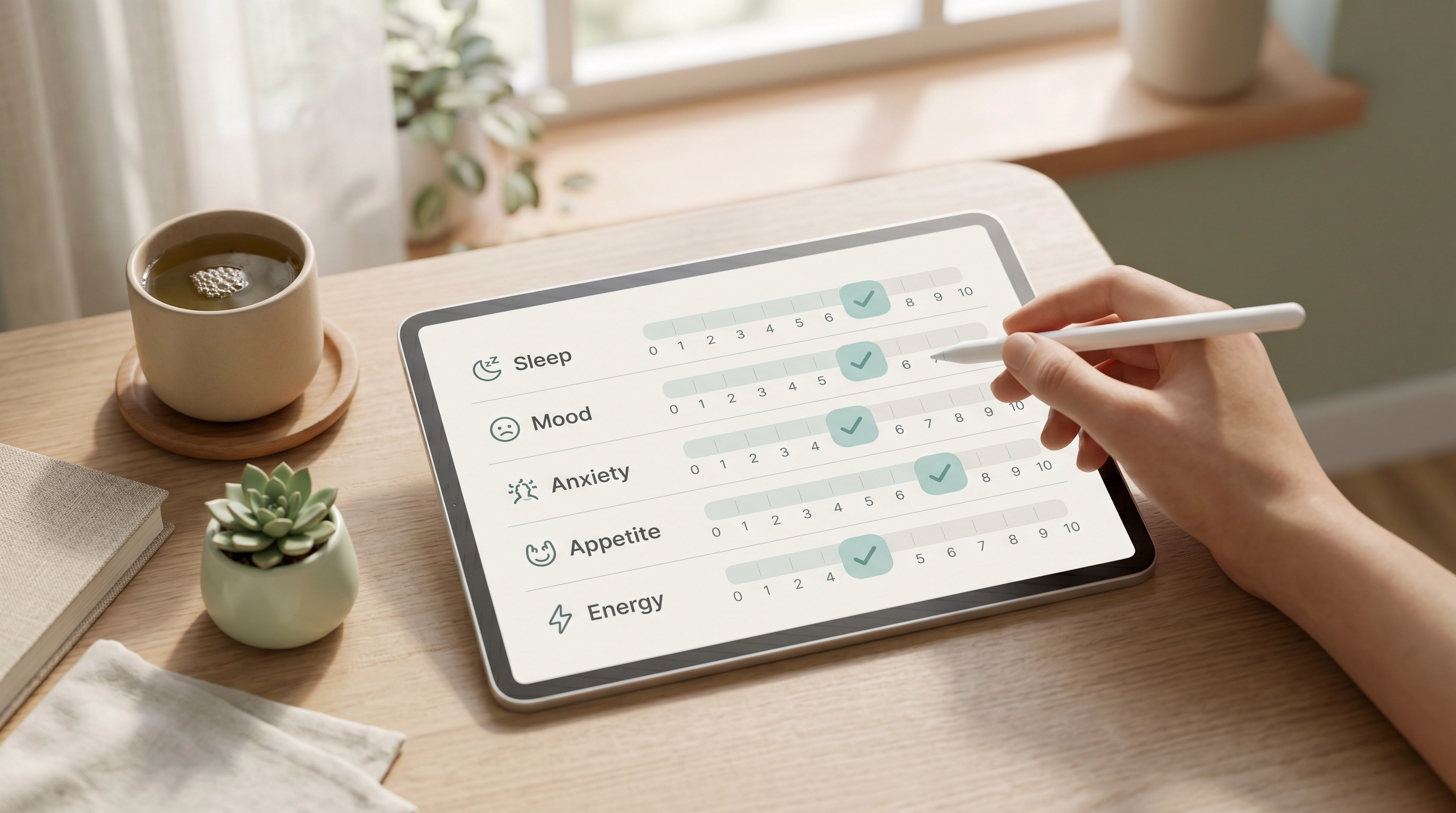
Most people walk into their first appointment with a blank slate. When the doctor asks, "How have you been sleeping?" or "How long has this been going on?" — memory fails. Stress distorts time. You might say "a few weeks" when it has actually been three months.
A simple log fixes that. Not because the doctor wants to read your deepest secrets, but because patterns beat recollections. A week or two of honest ratings gives them real data to work with.
What to Track (Keep It to Five)
Don't turn this into a research project. Pick five categories and rate them 0–10 daily. The most useful ones for a first visit:
- Mood / Anxiety — core diagnostic signal
- Sleep — disruptions show up in almost every mood disorder
- Energy / Apathy — helps distinguish depression from anxiety
- Appetite — often an early indicator something is off
- Daily Functioning — the #1 thing psychiatrists actually care about
Add a one-line note when a score is extreme. A 9/10 anxiety day with the note "argument with partner" is way more useful than the number alone.
How to Calibrate the 0–10 Scale
Don't inflate scores because the day felt terrible. Use this rough anchor:
- 0–2: Minimal impact. You noticed it, but you functioned normally.
- 3–5: Moderate. It slowed you down or required extra effort.
- 6–8: Severe. You avoided responsibilities or social contact because of it.
- 9–10: Crisis. You could not perform basic self-care or had intrusive thoughts of self-harm.
If you hit 9–10, skip the journal and call emergency services. The journal is a tool for pattern recognition, not a substitute for immediate safety.
How Many Days?
You don't need months of data. 10 to 14 days is the sweet spot — long enough to show a pattern, short enough that the details are still fresh in your memory. If you only have 3 days, bring them anyway. Three honest data points are better than zero.
What to Bring (and What to Leave Out)
Bring your daily ratings and one or two representative notes. Leave your raw emotional entries at home if you want — you don't have to share your deepest fears with a stranger on day one. The ratings table alone is enough to start the conversation.
One last thing: if you miss a day, just leave it blank. Don't try to catch up from memory — fake data is worse than no data.
Tracking sensitive mental health data? Make sure you're using a journal that actually keeps it private. MindsKeep's client-side encryption ensures everything is encrypted on your device before it ever touches a server — so you control what gets shared, and with whom.
Track Symptoms Privately on MindsKeep

Why I Stopped Trying to Journal Daily
Keywords: journaling habit, daily journaling, perfectionism, one sentence journal, habit stacking
Bottom line: The "write every day" rule is the fastest way to kill a journaling habit. One sentence is enough.
Two years ago I bought a fancy notebook. Wrote three pages on day one. Never opened it again.
The "write every day" rule is the fastest way to kill a journaling habit. One late night. One migraine. One week where opening a blank page feels like a performance review. And when the streak breaks, the shame kicks in. You avoid the journal because it now contains evidence of your failure.
I stopped trying to be perfect. That's when I actually started writing.
The One-Sentence Rule
Commit to one sentence per day. Not a paragraph. Not a page. One sentence. This removes the friction that kills habits.
Some days that's all you write. Other days it turns into three paragraphs. The goal is just opening the app — or the notebook — and putting something down.
Habit Stacking, Not Habit Forcing
Don't journal "in the morning." Journal right after you pour your coffee. The coffee is the cue. No willpower needed.
If you miss the coffee, you miss the journal. That's fine. There is no streak to protect.
Missed Days Are Data, Not Failure
A blank day is not a relapse. It is a day you were too overwhelmed to track, which is clinically relevant information in itself. The pattern of absence tells you just as much as the pattern of presence.
Permission slip: You do not owe this journal daily entries. You owe yourself honesty when you choose to write. The journal serves you. You do not serve the journal.
When to Write vs. When to Simply Live
There is a difference between avoiding journaling because you are lazy, and choosing not to journal because you are present.
- Avoidance: You feel an emotional surge, you think "I should journal this," and then you scroll Instagram instead. The thought haunts you.
- Presence: You feel an emotional surge, you sit with it, you talk to a friend, you take a walk, and the wave passes. No journal needed.
Both are valid. A journal is one of many tools. The goal is self-awareness, not journal volume.
From Perfection to Pattern
If you have been journaling sporadically for six months, you already have more data than you think. Instead of judging yourself for the blank days, look at the shape of your entries:
- Do they cluster around stress? You journal when overwhelmed — that's a coping mechanism, not a failure.
- Do they stop during good times? You journal when processing — that's also valid.
- Are the short entries actually more honest than the long ones? Brevity often strips away performance.
The pattern is the product. The consistency of depth matters far less than the consistency of returning.
Stop trying to journal daily. Start trying to journal honestly when you do. If you want a quiet space with no streak counters, no badges, and no social sharing, try MindsKeep.
Journal Without Pressure on MindsKeep
From Beginner to Pro: 5 Secrets to Building a Daily Journaling Habit
Keywords: journaling habit, how to start a journal, journaling tips, benefits of journaling, daily diary routine
Bottom line: You do not need to write pages. You need to show up. These five research-backed strategies will help you build a journaling habit that sticks.
Why Most People Quit Journaling
The benefits of journaling are well documented: reduced stress, improved emotional regulation, sharper decision-making, and stronger self-awareness. Yet most people abandon their journal within two weeks. The reason is not lack of willpower — it is unrealistic expectations.
Secret 1: Start Absurdly Small
Commit to one sentence per day. Not a paragraph. Not a page. One sentence. This removes the friction that kills habits. MindsKeep's clean, minimal editor makes it effortless to open the app and write that single line.
Secret 2: Anchor Journaling to an Existing Habit
Habit stacking works. Attach journaling to something you already do daily: morning coffee, evening skincare, or your commute. The cue triggers the behavior automatically. MindsKeep syncs across devices, so your journal is always within reach — phone, tablet, or laptop.
Secret 3: Use Prompts When Stuck
"I don't know what to write" is the #1 barrier. Keep a list of prompts:
- What am I grateful for today?
- What challenged me, and what did I learn?
- If I could change one decision from today, what would it be?
- What emotion am I avoiding right now?
MindsKeep's AI tagging can even suggest reflection prompts based on your past entries.
Secret 4: Review Regularly
A journal you never read is a diary you never learn from. Schedule a 10-minute monthly review. MindsKeep's calendar view and AI monthly summaries make this trivial — you get a birds-eye view of your month in seconds.
Secret 5: Lower the Stakes
Your journal does not need to be profound. Grammar does not matter. Spelling does not matter. No one is grading you. The value is in the process, not the product. MindsKeep has no word counts, no streak counters, no social sharing — just a quiet space to think.
The MindsKeep Difference
Building a daily journaling habit requires a tool that gets out of your way. MindsKeep combines:
- A distraction-free editor with rich text formatting
- Cross-platform sync so you never lose momentum
- AI insights that reward consistency with meaningful feedback
- Privacy that lets you be completely honest — secured by zero-knowledge encryption
The best journal is the one you actually use. Start today — one sentence is enough.
Begin Your Journaling Habit on MindsKeep