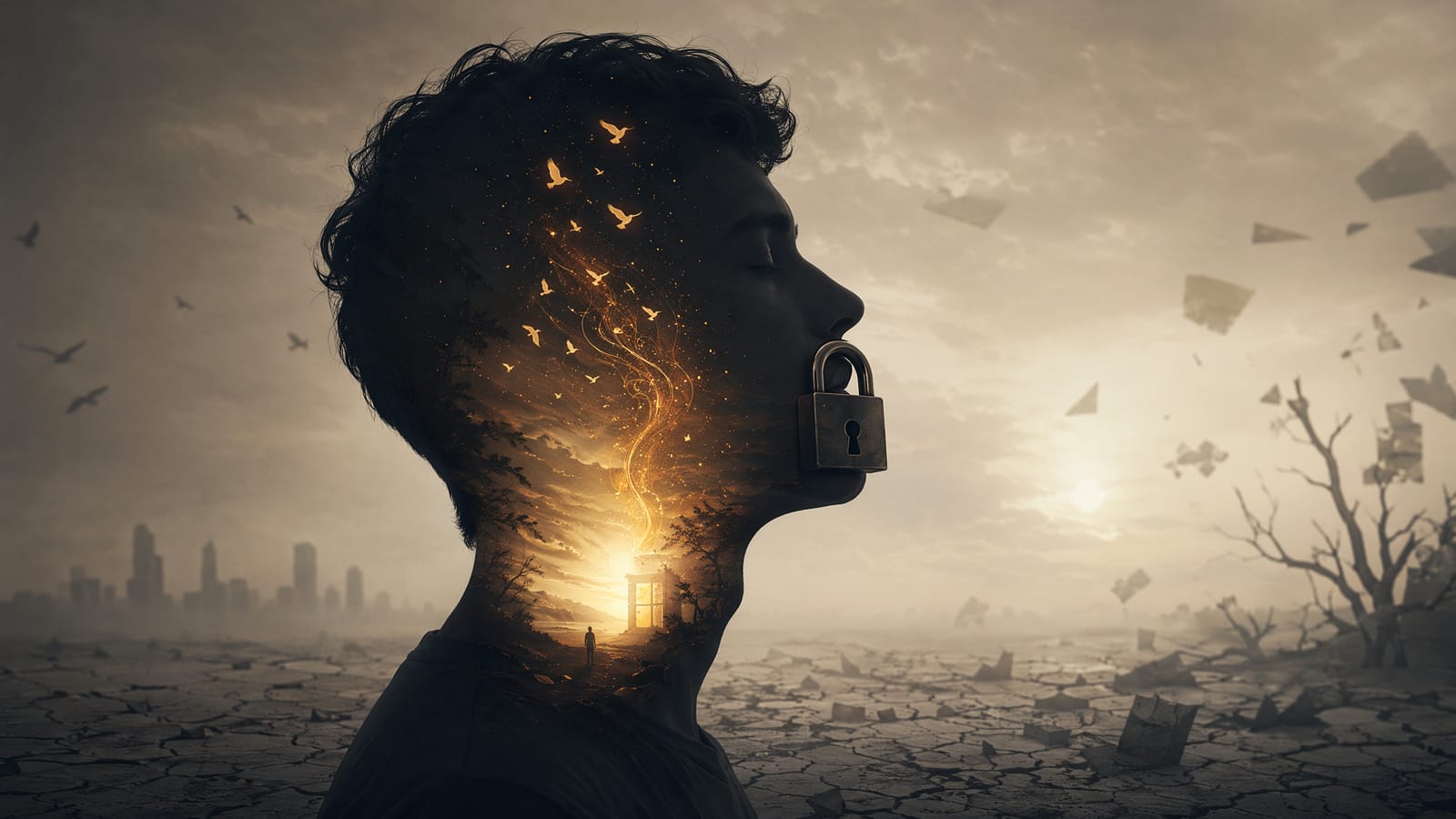
The Silent Burden: How Self-Censorship Undermines Authenticity and Well-being
The Core Insight: Self-censorship, often a strategic response to perceived social risks, can lead to significant psychological costs, including reduced well-being and a fragmented sense of self. Private, secure journaling offers a powerful antidote, fostering authenticity and emotional resilience [1].
We’ve all been there: a thought bubbles up, a strong opinion forms, a raw emotion surfaces. But before it can be voiced, a subtle internal calculation takes place. What will others think? Will I be judged? Will it cause conflict? In a split second, the thought is rephrased, softened, or perhaps, swallowed whole. This isn't just politeness; it's a pervasive, often unconscious act of self-censorship, a silent burden many carry in an increasingly interconnected and opinionated world. While sometimes necessary for social harmony, habitual self-censorship can exact a heavy toll on our mental health and sense of authenticity [1].
What is Self-Censorship?
Self-censorship, in its broadest sense, is the act of intentionally restricting one's own expression or behavior to avoid perceived negative consequences, such as social disapproval, punishment, or isolation [1]. It's a strategic response, as researchers at Arizona State University and the University of Michigan have shown, where individuals weigh the desire to express dissent against the fear of repercussions [2]. This can manifest in various ways:
- Opinion Conformity: Adjusting one's expressed views to align with perceived group norms, even if they differ from privately held beliefs [1].
- Complete Silence: Choosing not to express one's views at all when perceiving them as misaligned with prevailing opinions [1].
- Preemptive Self-Silencing: Restraining self-expression before any punishment occurs, making it a powerful tool for social control [2].
"Self-censorship can start as a form of self-protection. But when people begin to silence themselves preemptively, before any punishment occurs, it becomes a powerful tool for control."
Joshua J. Daymude, ASU Study on Self-Censorship [2]
The Psychological Costs of Silence
While self-censorship can be a survival mechanism in certain environments, its chronic practice has significant psychological repercussions:
- Erosion of Authenticity: Constantly suppressing one's true thoughts and feelings can lead to a fragmented sense of self, where the public persona diverges significantly from the private self. This can result in feelings of inauthenticity and a loss of personal identity [1].
- Increased Stress and Anxiety: The internal effort required to monitor and filter one's expression is a form of cognitive load, leading to chronic stress. Studies show a strong association between self-censorship at work and higher fear of social isolation, burnout, and lower job satisfaction [3].
- Reduced Well-being: When individuals cannot freely express themselves, it can hinder emotional processing and lead to emotional numbing. This lack of emotional disclosure is linked to decreased psychological resilience and overall well-being [1].
- Hindered Personal Growth: Authenticity is crucial for personal growth. When we self-censor, we deny ourselves the opportunity to explore challenging ideas, receive constructive feedback, and evolve our perspectives.
Private Journaling: The Antidote to Self-Censorship
In a world that often demands conformity, private journaling emerges as a powerful sanctuary for unfiltered self-expression. Unlike public platforms where every word is scrutinized, a personal journal offers a space free from judgment, surveillance, or the threat of punishment. This absolute privacy is not just a luxury; it's a psychological necessity for genuine self-disclosure [4].
Within the pages of a private journal, you can:
- Explore Unfiltered Thoughts: Write down every thought, no matter how controversial or unconventional, without fear of external repercussions. This allows for genuine self-exploration and understanding.
- Process Raw Emotions: Give voice to anger, fear, joy, or sadness without needing to manage others' reactions. This emotional release is crucial for mental well-being and can reduce the intensity of difficult feelings [1].
- Reconcile Public and Private Selves: Use the journal as a bridge to understand the discrepancies between who you are publicly and who you are privately, fostering a more integrated and authentic self.
- Cultivate Boldness: Regularly practicing unfiltered expression in a private space can gradually build the confidence to articulate your authentic self in other areas of your life, albeit with discernment.
MindsKeep: Your Sanctuary for Authenticity
MindsKeep is built on the foundation of absolute privacy, making it an ideal tool for combating the effects of self-censorship. With client-side encryption, your most intimate thoughts and feelings are secured before they ever leave your device, ensuring that your journal remains a truly private space. This technological assurance of privacy fosters an environment where you can freely express yourself, knowing that your words are for your eyes only. By removing the fear of external judgment or data exploitation, MindsKeep empowers you to engage in deep, authentic self-reflection, helping you to:
- Reduce Cognitive Load: Offload the mental burden of self-monitoring and filtering.
- Enhance Emotional Processing: Freely label and explore complex emotions without reservation.
- Strengthen Self-Identity: Reconnect with your authentic voice and values.
Reclaiming Your Voice: A Journaling Protocol
To begin using private journaling as a tool against self-censorship, consider this structured approach:
- The Unfiltered Brain Dump (Daily, 10 minutes): Start each journaling session by writing continuously, without editing or censoring, for a set period. Let every thought, feeling, and observation flow onto the page. The goal is quantity and raw honesty, not coherence.
- The "Why Did I Censor?" Reflection (Weekly): At the end of each week, review moments where you felt you self-censored in your daily life. Write about the situation, the thought you suppressed, and the perceived fear or consequence that led to the censorship. Explore alternative responses you might have taken.
- The Values Clarification Exercise (Monthly): Dedicate a session to writing about your core values. How do your actions align with these values? Where does self-censorship create a misalignment? This helps reinforce your authentic self.
- The "Unsent Letter" (As Needed): If a specific person or situation triggers strong self-censorship, write an unsent letter to them in your journal. Express everything you wish you could say, without holding back. This is a powerful tool for emotional release and gaining clarity [5].
Conclusion: The Power of Your Authentic Self
The silent burden of self-censorship can subtly erode our authenticity and well-being, leaving us feeling disconnected from our true selves. However, by embracing the power of private journaling, particularly within a secure platform like MindsKeep, we can create a sanctuary for unfiltered expression. This practice not only helps us process complex emotions and understand our inner landscape but also empowers us to reclaim our voice, foster genuine authenticity, and ultimately, live a more integrated and fulfilling life. Your thoughts are yours alone; let them flourish in freedom.
Start Your Private Journaling Journey with MindsKeepReferences
- Simply Psychology Editorial. (2026, June 3). Digital Minimalism and Mental Health: Research on Intentional Tech Use. *Simply Psychology*.
- deVos, K. (2025, November 4). When speaking out feels risky: ASU study reveals the hidden dynamics of self-censorship. *ASU News*.
- Sinclair, S., Nilsson, A., & Holm, K. (2024). The role of political fit and self-censorship at work for job satisfaction, social belonging, burnout, and turnover intentions. *Current Psychology*, 43, 20935–20947.
- Cho, J., & LaRose, R. (2019). Privacy Concerns and Self-Disclosure in Private and Public Uses of Social Media. *Journal of Broadcasting & Electronic Media*, 63(3), 395-414.
- The British Psychological Society. (n.d.). How unsent letters helped me find words. *The Psychologist*.