The Replay That Never Ends
Key takeaway: The way you relive a painful memory decides whether it heals or harms. When you stay immersed in the first person, replaying "how could they do that to me?" keeps the wound open. When you step a small distance back and watch the scene as an observer — asking why that person was upset — the same event becomes reflective rather than ruminative. Self-distancing is a learnable viewing angle, not a personality trait, and a journal is the easiest place to practice it.
It happened days ago, but the conversation is still playing. A curt reply, a glance that lingered too long, a decision made in the moment and regretted ever since. You lie awake rehearsing it, changing the lines, imagining the version where you handled it well. Each replay feels like progress — you are thinking about it, after all — yet morning arrives and you feel exactly as stuck as the night before. This is the paradox at the heart of how we process pain: facing a memory should help, but doing it the wrong way only deepens the hole.
We are usually taught to either push the memory away or lean into it fully — "feel your feelings," we are told, "don't bottle it up." Both pieces of advice are right, and both are dangerously incomplete. What the last twenty years of research on self-distancing has shown is that the missing ingredient is not how hard you look, but where you stand when you look. A small shift in perspective — almost cinematic, like moving the camera one step back — changes everything about what the memory does to you.
Two Ways to Relive a Painful Moment
When people revisit a negative experience, they do it in two strikingly different ways, and researchers can tell them apart almost as soon as someone begins to describe what happened. One way keeps you trapped; the other lets you learn. The difference is not the event itself. It is the viewing angle.
Inside the Camera vs. Behind It
Immersed means reliving the memory through your own eyes, as if you are back inside the camera that filmed it. You see the room from your height, you hear the words with your own ears, and the feeling floods you again. The grammar is first-person: "I was so hurt. I can't believe they said that. How could this happen to me?" Immersed processing feels like thinking, but it mostly re-experiences.
Self-distanced means watching the memory from a few steps back, as if it were a scene unfolding in front of you on a small stage. You can still see yourself in it — you do not disappear — but now you are looking at the person in the scene, not through their eyes. The grammar quietly shifts to the third person: "She was hurt because that remark landed on an old wound. He reacted the way he did because he was under pressure." This single move — from "I" to "she," from inside to slightly outside — is the entire technique.
When people reflect on their negative experiences from a self-distanced rather than an immersed perspective, they are able to resolve their feelings, derive meaning from those experiences, and do so without reactivating their negative affect.
Ethan Kross & Özlem Ayduk, Current Directions in Psychological Science (2011)
Why Asking "Why?" Hurts From Inside
You have probably been told that insight comes from asking why you feel the way you do. And it is true — except when it isn't. The same question, "why," can either calm you down or pour gasoline on the fire, depending entirely on where you stand when you ask it.
The landmark study here asked people to revisit a recent anger episode. Half were told to analyze their feelings from an immersed, first-person point of view; the other half were told to do the same analysis from a distanced, third-person one, as if watching themselves from afar. The immersed group got angrier and more agitated the more they asked why. The distanced group calmed down and actually made sense of what happened [1]. Asking "why" while you are inside the pain is not insight — it is rehearsal. You end up re-litigating the feeling rather than understanding it.
From a Distance, "Why" Becomes Wisdom
Why does distance help so much? Because when you are immersed, the brain treats the memory as if it is happening again right now. Threat circuits switch on, and reasoning takes a back seat. When you step back, the memory becomes an object to think about rather than a fire to be inside. You can ask the same questions — What was really bothering me? What does this say about what I value? — and now they produce insight instead of agony. People who spontaneously self-distance after a conflict report less negative emotion, less rumination, and clearer ideas about how to handle similar situations next time [2].
This is also why giving advice to a friend is usually easier than taking it. When your friend is upset, you are naturally outside the scene; you see the bigger picture, you cut them slack, you imagine their options. When the same event happens to you, the camera is pressed to your face and the picture narrows to a single hurt. Self-distancing is the deliberate act of borrowing that friend's vantage point for yourself.
What It Does to Your Body and Mind
The effect is not just a feeling — it shows up in physiology and in behavior. In a now-famous line of experiments, people who talked to themselves using their own name and the second person — "You can do this" rather than "I can do this," or "Alex is nervous because..." rather than "I'm nervous" — regulated their emotions better under stress, showed lower cardiovascular reactivity, and reasoned more wisely about interpersonal problems [3]. Small verbal shift, measurable calming effect.
There is a boundary worth knowing. Self-distancing reliably reduces the raw sting of basic emotions like anger and sadness, but for intensely self-conscious feelings — shame, embarrassment, the experience of being judged — pure distance can sometimes feel like escaping from the scene rather than understanding it [4]. That is why the practice below pairs distance with warmth: you step back to see clearly, but you do not step away from caring. Distance is a viewing lens, not an eraser.
Distance Is Not Detachment
The biggest misunderstanding about self-distancing is that it means becoming cold, robotic, or numb — treating your own pain like a science experiment. That is the opposite of the goal. You are not trying to stop caring; you are trying to care in a way that does not drown you.
Compassion Still Comes First
Think of the difference between a surgeon and a corpse. A surgeon must maintain a quiet, precise distance in the operating room — not because they do not care, but because closeness that trembles cannot help. The distance here is professional kindness: steady, observant, on your side. You are the patient and the surgeon at once. You notice the anger without being swept by it, you name the hurt without becoming it, and from that slightly cooler place you can decide what actually deserves a response [5].
This is why self-distancing is especially powerful the moment you feel most hooked. A sharp message lands, your chest tightens, and the first urge is to fire back or to ruminate for hours. That exact moment is when a step back — "Okay, what just happened here, and why does it matter so much?" — changes the trajectory. You are not suppressing the feeling; you are creating the ten inches of space in which a wiser version of you can act.
The Self-Distancing Journal: A Four-Step Practice
Writing is the ideal training ground for this, because the page enforces distance by its very nature — whatever you put on paper is already outside you, an object you can look at. The following exercise takes about fifteen minutes and is designed for the moments when a memory keeps returning. Resist the urge to write in the raw first person; the whole point is to shift the camera.
Step 1 — Set the scene as a witness. Describe what happened in the third person, as if you were narrating a short film about someone else. "On Tuesday afternoon, Maya sent the email. Her colleague replied in a curt tone. Maya felt a flush rise..." Use your name or "you," not "I." Keep it factual: who was there, what was said, what was done.
Step 2 — Ask why, from across the room. Now explain the feelings, but stay outside. "Why did Maya react this way? What need of hers was threatened? What was her colleague likely carrying that day?" This is where the insight lives — reasons that were invisible while you were inside the scene.
Step 3 — Separate what is yours from what isn't. From the observer chair, mark the line. "Maya is responsible for how she replied. She is not responsible for her colleague's bad day or for the ambiguous email thread from last month." Distance makes this line far easier to draw than immersion does.
Step 4 — Write the wiser next move. End with one concrete choice for the next similar moment, addressed to that person in the third person: "Next time, Maya will wait two hours before answering, and she will ask what the colleague meant instead of assuming." Close the page; the replay has been converted into a plan.
Writing in the Third Person
Writing "she" instead of "I" feels unnatural at first — almost disrespectful, as if you are talking about a stranger. That small friction is the technique working. Each time you catch yourself sliding back into "I," gently translate the sentence back to third person. You are not lying; you are choosing a wider lens. Over a few sessions the perspective becomes available in real life, not just on the page. People who practice this begin to catch themselves mid-conflict and think, almost reflexively, Okay, step back. What is really going on here?
A useful complement is the short form: when a spike of anger or anxiety hits during the day, pause and silently narrate it using your own name — "Sam is feeling judged right now, and that feeling is old, not about this." Research on self-distanced self-talk suggests this tiny verbal shift alone lowers the heat of the moment [3]. You do not need a full page for it; you need ten seconds and a willingness to be the observer of your own experience.
Becoming the Observer You Needed
There is a quiet kind of maturity in realizing that the person who can best calm you down is not some expert on a screen — it is you, but only when you stand in the right place. Immersed, you are the one screaming in the storm. Distanced, you are the one holding the lamp, describing the storm to someone safely inside. Both are you. The second one is the wiser you, and it gets stronger the more you visit it.
This does not mean the hard moments become easy or that hurt disappears. It means you stop being swallowed by the hurt and start being the person who can look at it, understand it, and decide what it is worth. The memory does not have to vanish; it has to stop running your life. A journal gives you a daily place to move the camera back, until stepping outside yourself becomes the default instead of a rescue you have to remember.
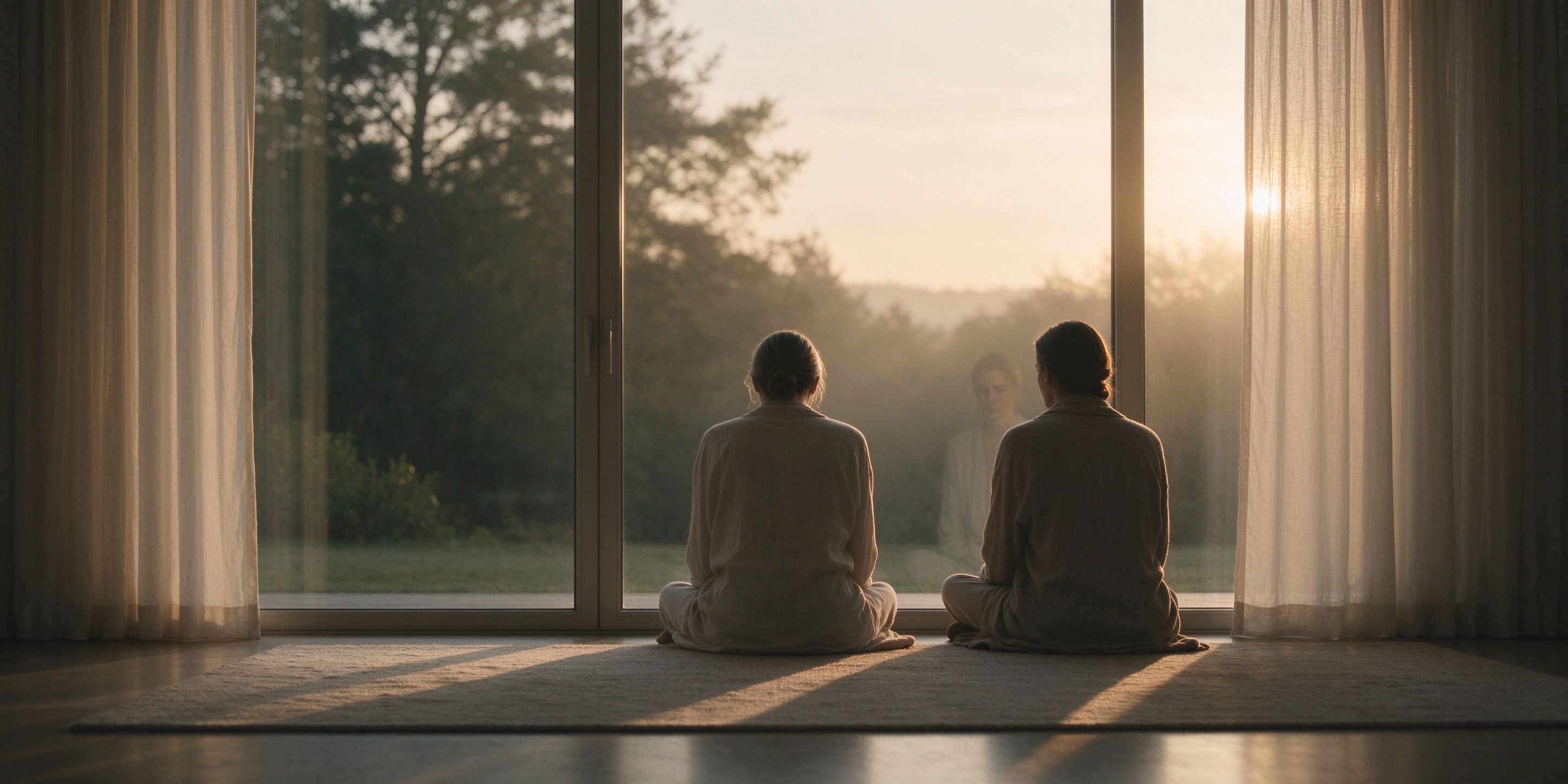
The next time the replay begins, try the small experiment. Do not force the feeling away, and do not drown in it. Take one step back on the page, switch "I" for your name, and describe the scene to the calmest person you know — the one sitting quietly beside you. That person, it turns out, has been there all along.
Try MindsKeep — Free & EncryptedReferences
- Kross, E., Ayduk, O., & Mischel, W. (2005). When asking "why" does not hurt: Distinguishing rumination from reflective processing of negative emotions. Psychological Science, 16(9), 709–715.
- Ayduk, Ö., & Kross, E. (2010). From a distance: Implications of spontaneous self-distancing for adaptive self-reflection. Journal of Personality and Social Psychology, 98(5), 809–829.
- Kross, E., Bruehlman-Senecal, E., Park, J., Burson, A., Dougherty, A., Shablack, H., Bremner, R., Moser, J., & Ayduk, O. (2014). Self-talk as a regulatory mechanism: How you do it matters. Journal of Personality and Social Psychology, 106(2), 304–324.
- Katzir, M., & Eyal, T. (2013). When stepping outside the self is not enough: A self-distanced perspective reduces the experience of basic but not of self-conscious emotions. Journal of Experimental Social Psychology, 49(6), 1089–1092.
- Kross, E., & Ayduk, O. (2011). Making meaning out of negative experiences by self-distancing. Current Directions in Psychological Science, 20(3), 187–191.