The Notebook, the Laptop, and the Rain
Bottom line: Handwriting slows you down in ways that deepen memory and meaning. Typing lowers the barrier to honest, unguarded flow. The research does not crown a single winner—it points to something more useful: match the medium to the purpose, and protect the privacy of whatever you write. Your mind benefits most from generation, not from the instrument you generate with.
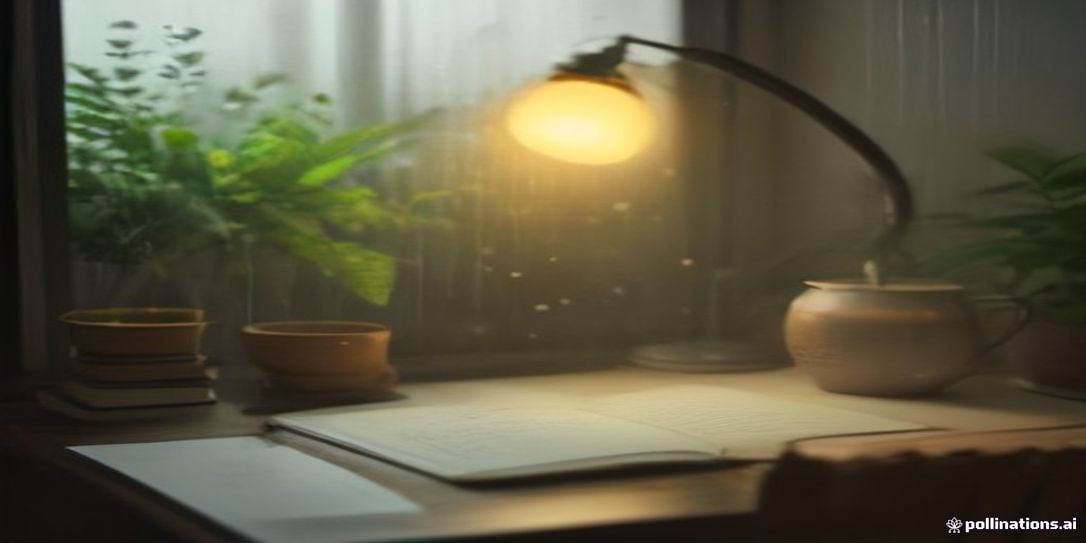
It is raining on a Sunday afternoon—the steady, gray kind of rain that cancels your plans for you. The kettle is on. You have twenty unclaimed minutes and a head still humming with a conversation from Friday that did not go the way you wanted. You sit at your desk.
On the left: a paper notebook, its spine cracked from weeks of disuse. On the right: your laptop, already open, cursor blinking patiently. And you freeze. Not over what to write. Over how.
If you have ever paused at this exact fork, you are in good company. The handwriting-versus-typing debate has been running for two decades, and both sides arrive armed with studies. Let us walk through what the science actually says—and then answer the question almost nobody asks, which is the one that matters most.
What Handwriting Does to Your Brain
In 2014, psychologist Pam Mueller, then at Princeton, and Daniel Oppenheimer of UCLA ran a study that has been quoted in every stationery aisle since. College students watched TED talks and took notes—half in longhand, half on laptops [1]. The laptop group wrote more. They captured more words, nearly verbatim. And on the conceptual questions afterward, the longhand group won decisively.
The reason is not romantic. It is mechanical. Handwriting is slow—the average adult writes around 13 to 20 words per minute, versus 40 or more when typing. Because you physically cannot transcribe everything, you are forced to compress, paraphrase, and translate the idea into your own words in real time. That act of selection is the learning. The notes are shorter because the understanding happened earlier.
It may be that longhand note takers engage in more processing than laptop note takers, thus selecting more important information to include in their notes.
Pam A. Mueller, Psychological Science, 2014 [1]
The brain imaging agrees. In a 2012 study at Indiana University, neuroscientist Karin James and her colleague Laura Engelhardt scanned pre-literate children before and after handwriting practice. After learning to form letters by hand, the children showed activation in brain regions tied to reading and visual recognition—activation that typing practice simply did not produce [2]. Something about shaping the symbol seems to wire the symbol in.
And University of Washington psychologist Virginia Berninger found that children wrote more words, wrote them faster, and generated more ideas when composing by hand than when typing [3]. Her conclusion, echoed across two decades of her lab’s work, is quietly radical: handwriting does not just record thinking. It appears to feed it.
Where Typing Quietly Wins
Now the other side of the desk, because it deserves honesty too.
Speed. At 2 a.m., when thoughts are arriving faster than your hand can form letters, typing keeps pace with a racing mind. A journal entry that would take twenty painful minutes by hand takes five. For busy people—which is to say, most people—the difference between a practice that happens and one that does not is often exactly that fifteen minutes.
Disinhibition. Here is something therapists who use writing in their work will tell you: many people find it easier to type the unspeakable sentence than to commit it to paper in their own handwriting. The screen adds a thin, strange layer of distance—the words are yours, yet not quite touching you. If your journaling stalls on the very entries that matter most, the keyboard may be the kinder door.
Practical power. Search across six years of entries in a second. Edit without crossed-out scars staring back at you. Back up automatically. And—we will come back to this—encrypt, so that no one but you can ever read a word.
One caution from the Mueller and Oppenheimer research deserves repeating: laptops invite verbatim mode. When you type like a stenographer, you process like one [1]. Journaling prompts are not lectures, so the risk is smaller—but the principle holds. Type slowly enough to think, or you are just taking dictation from your own noise.
The Real Mechanism: Generation, Not the Pen
So which is it—pen or keyboard? UCLA psychologist Robert Bjork spent a career on a concept that dissolves the question: desirable difficulties. Conditions that feel harder during learning—slower, less fluent, slightly effortful—often produce far stronger memory and understanding than smooth, easy performance [4]. The struggle is not a bug. The struggle is the mechanism.
Both media can supply that productive struggle. Handwriting supplies it through motor slowness. Typing can supply it through structure: a demanding prompt that forces you to compress a tangled week into three honest sentences. The instrument varies; the generation is the constant.
And this is where the most important evidence arrives. In Dr. James Pennebaker’s landmark studies on expressive writing, the healing was never about penmanship. Participants who wrote about emotional upheaval—on keyboards, in most of the later studies—showed measurable gains in physical and psychological health. What drove the benefit was the act of constructing a narrative: organizing raw feeling into language, finding causal threads, building meaning out of chaos [5]. Any medium that gets you constructing works. The pen is one road. It is not the only one.
The Blue Notebook
When I was twenty-four, I kept a blue cloth notebook. I wrote in it for three years—through a breakup, a move to a new city, my first real job. It knew everything about me.
Then, during a move, with boxes stacked in every room, someone I trusted picked it up. They were only flipping. They read one line aloud, laughing—an entry about my mother’s surgery, of all things—and I laughed too, because what else do you do. But something in me closed like a door. I kept the notebook. I stopped writing in it. For two years.
I did not stop because I had nothing to say. I stopped because the notebook no longer felt like a container. It felt like a stage.
I resumed only when I found a place where every entry is encrypted on my own device before it goes anywhere—where even the people running the servers cannot read what I write. My handwriting, on a screen, is worse than it was at twenty-four. The honesty is total. The twenty-minute pause at my desk on rainy Sundays vanished the day the audience did.
The Seven-Day Dual-Channel Experiment
Reading about this will only take you so far. The useful move is to run the experiment on yourself—one week, both channels, careful attention. Here is the protocol:
The Seven-Day Dual-Channel Experiment
Days 1–2 – Handwrite: Ten minutes of stream-of-consciousness, pen on paper. Do not stop, do not reread, do not correct. Write about whatever is loudest in your head.
Days 3–4 – Type: Same free-writing rule, same ten minutes, on a keyboard. Notice—without judging—where the words come easier and where they blur past.
Day 5 – Honesty test: Use whichever mode felt safer. Write about the thing you have been avoiding writing about.
Day 6 – Clarity test: Use whichever mode felt clearer. Write about one decision you are facing, ending with the next small step you can actually take.
Day 7 – Compare: Reread the week. Ask three questions: Which entries surprised me? Which mode produced them? Which entries will I actually come back to? Your answers, not any study, define your practice.
Why Privacy Decides the Debate
Step back and look at what the research keeps circling. Slowness. Generation. Honesty. Every claimed benefit of journaling—deeper memory, clearer emotion, real insight—flows from writing that is unguarded. And unguarded writing has a quiet prerequisite: you must be certain no one is reading over your shoulder. Not a partner. Not a colleague. Not an algorithm. No one.
Paper can be found—ask my blue notebook. Ordinary documents can be opened, synced, shared, left glowing on a screen. An encrypted journal removes the audience entirely: entries are locked on your own device, indecipherable to anyone without your key, before they travel anywhere at all. That is not a feature on a spec sheet. It is the difference between writing for yourself and writing for the room.
So, does handwriting beat typing? For memory and idea generation, the pen has real science behind it [1][2][3]. For speed, flow, and candid disclosure, the keyboard gives nothing away [5]. But the deepest benefit of journaling belongs to whichever medium you will use—regularly, slowly, and completely without armor. Choose the instrument you will not flinch from. Then make sure the door is locked.
Try MindsKeep — Free & EncryptedReferences
- Mueller, P. A., & Oppenheimer, D. M. (2014). The pen is mightier than the keyboard: Advantages of longhand over laptop note taking. Psychological Science, 25(6), 1159–1168.
- James, K. H., & Engelhardt, L. (2012). The effects of handwriting experience on functional brain development in pre-literate children. Trends in Neuroscience and Education, 1(1), 32–36.
- Berninger, V. W., Abbott, R. D., Jones, J., Wolf, B. J., Gould, L., Anderson-Youngstrom, M., Shimada, S., & Apel, K. (2006). Early development of language by hand: composing, reading, listening, and speaking connections; three letter-writing modes; and fast mapping in spelling. Developmental Neuropsychology, 29(1), 61–92.
- Bjork, R. A., & Bjork, E. L. (2011). Making things hard on yourself, but in a good way: Creating desirable difficulties to enhance learning. In M. A. Gernsbacher, R. W. Pew, L. M. Hough, & J. R. Pomerantz (Eds.), Psychology and the Real World (pp. 56–64). Worth Publishers.
- Pennebaker, J. W. (1997). Writing about emotional experiences as a therapeutic process. Psychological Science, 8(3), 162–166.