The Zen Striker
Bottom line: Erling Haaland does not just score goals—he meditates through them. His secret weapon is not physical strength alone, but a disciplined mind trained in stillness, presence, and radical simplicity. And the tools he uses are accessible to anyone willing to practice.
The World Cup Stage and the Man Behind the Goals
On June 16, 2026, a nation held its breath. Norway, absent from the World Cup for 28 years, stepped onto the pitch in Foxborough, Massachusetts, to face Iraq in their Group I opener. Within 28 minutes, Erling Haaland had already scored. By halftime, he had a second. Norway won 4-1, and a star was not just born—he was reborn on the world's biggest stage [1].
Two group games later, Haaland sat out the final match against France—a controversial but calculated decision by manager Ståle Solbakken, who called the tournament a "pressure cooker" and insisted that rest was essential for the knockout rounds [2]. The gamble paid off. In the Round of 32, facing Ivory Coast, Haaland scored an 86th-minute winner to send Norway through to a clash with Brazil—his fifth goal of the tournament, placing him second in the Golden Boot race behind only Lionel Messi [3].
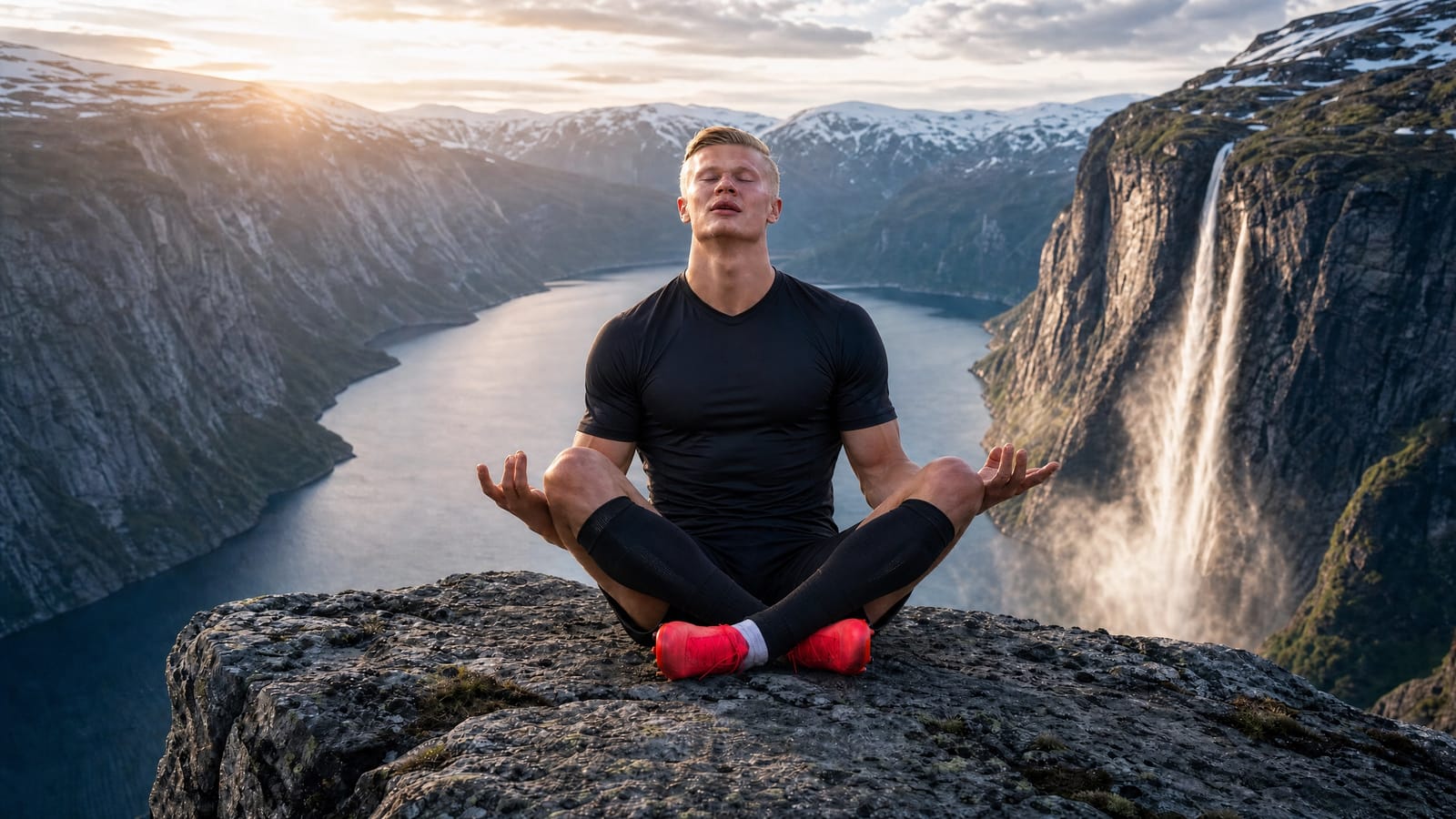
But here is what the highlight reels do not show: the man who scored that winner lives a life of near-monastic discipline. He meditates daily. He avoids nightlife. He tapes his mouth shut to sleep better. And when he celebrates, he does not dance or scream—he sits cross-legged in a lotus position, closes his eyes, and breathes.
The Lotus Celebration: Meditation as a Way of Life
Haaland's now-iconic "zen" celebration—sliding into a seated meditation pose, index fingers touching thumbs, eyes closed—is not a gimmick. It is a genuine reflection of a practice he began years ago at Molde FK in Norway and has carried through Salzburg, Dortmund, and Manchester City [4].
I really enjoy meditation. It makes me feel calm and gives me tranquillity. This is why I sometimes celebrate like that when I score.
Erling Haaland, on his signature celebration [4]
In July 2024, Haaland posted a video of himself meditating on a rock beside a flowing stream, surrounded by forest. While Euro 2024 finalists clashed in Berlin, he sought stillness in nature. The contrast was deliberate: chaos on one screen, serenity on his [5]. This is not avoidance. It is preparation.
For Haaland, meditation is functional. It lowers cortisol, activates the parasympathetic nervous system, and creates what sports psychologist George Mumford calls "space between stimulus and response"—the milliseconds that separate a reactive mistake from a composed decision [5]. When a defender pulls your shirt, when the crowd roars, when the knockout round hangs on a single touch, that space is everything.
A Monk in Cleats: The Discipline of Simplicity
What is most striking about Haaland is not his physical dominance—though at 6'4" and built like a Nordic god, that is hard to miss. It is his lifestyle. In an era when athletes are also influencers, brand ambassadors, and nightlife personalities, Haaland does almost nothing.
"People ask me, what do you do?" he said in a 2026 interview. "I really don't do anything. I wake up, have breakfast, train, get treatment, go home, relax, prepare for the next training, cook dinner, go to sleep" [6]. No clubs. No excess. No distractions. He even sleeps with mouth tape to improve breathing and recovery [6].
This is not boredom. It is boundaries. Haaland has built a life where every decision protects his focus. He understands a truth that eludes most high-performers: mental energy is finite, and every trivial decision—what to wear, where to eat, who to text—depletes the same reservoir needed to read a defense or convert a half-chance.
Research on ego depletion, though debated, suggests that simplifying daily routines preserves cognitive resources for high-stakes moments [7]. Haaland's life is a masterclass in this principle. By removing noise, he amplifies signal.
Present-Moment Mastery: The Psychology of Peak Performance
Perhaps Haaland's most powerful mental habit is his relationship with time itself. He does not dwell on the last missed chance. He does not fantasize about the final whistle. He exists only in the now.
Before matches, I don't think too much about the game. I try to live in the moment, not think about what happened yesterday, not think about what will happen tomorrow.
Erling Haaland, on his pre-match mindset [6]
This is the core of mindfulness: non-judgmental awareness of the present moment. It sounds simple, but under the stadium lights of a World Cup knockout match, with millions watching and a nation's hopes on your shoulders, the present moment is the hardest place to be. The mind wants to flee—to the past (that goal I missed) or the future (what if we lose?). Haaland trains it to stay.
Studies on mindfulness in athletes have shown significant improvements in focus, emotional regulation, and recovery. A nine-week mindfulness program with collegiate footballers in the United States found enhanced concentration and calmer decision-making under pressure [5]. A six-week program with professional players in Mexico demonstrated reduced stress, faster recovery, and greater mental clarity during competitive seasons [5]. Haaland is not following a trend. He is following evidence.
The Science of Athletic Mindfulness
The neuroscience behind Haaland's practice is robust. Mindfulness meditation has been shown to reduce amygdala reactivity—the brain's threat-detection center—while strengthening prefrontal cortex regulation, the area responsible for executive function and impulse control [8]. In practical terms, this means a meditating athlete is less likely to panic, more likely to see the pass, and more capable of slowing the game down when others are speeding up.
Controlled breathing—a staple of Haaland's routine—stimulates the vagus nerve, shifting the autonomic nervous system from sympathetic ("fight or flight") to parasympathetic ("rest and digest") dominance [9]. This physiological shift is why England's players now use breathing coaches during penalty shootouts, and why Haaland can celebrate a goal by literally lowering his heart rate [5].
Visualization, another component of meditative practice, has been shown to activate the same neural pathways as physical practice. When Haaland sits in stillness and imagines the ball at his feet, his brain fires in patterns remarkably similar to actual play [10]. He is training without moving.
The Pressure Paradox: Turning Anxiety Into Fuel
Haaland's relationship with pressure is unusual. Most athletes claim to "block out" pressure. Haaland leans into it—but on his own terms.
"I like to have pressure. I like challenges," he has said. "But I hate feeling stressed, and I try to avoid stress. The nature of meditation is trying to let go of those thoughts, and it works very well for me" [6].
This is the pressure paradox: he craves high stakes but rejects the physiological stress that usually accompanies them. Meditation is the bridge. By training his nervous system to remain calm in simulated stillness, he conditions it to remain calm in genuine chaos. The World Cup is not a threat to his body's stress response because his body no longer recognizes it as one.
It is worth noting that Haaland grew up with pressure. His father, Alfie Haaland, was a professional footballer for Norway. His mother, Gry Marita Braut, was a national champion in the heptathlon. He was bred for performance—but chose mental mastery as his differentiator.
Your Own Mental Training Ground: A Journaling Exercise
You do not need a World Cup stage or a forest stream to practice what Haaland practices. You need a quiet space, a few minutes, and a willingness to observe your own mind. Journaling can serve as the perfect complement to meditation—externalizing the internal, making the invisible visible.
Here is a simple exercise, inspired by Haaland's routine, that you can use before any high-pressure moment—a presentation, a difficult conversation, or simply the start of a demanding day:
The "Zen Striker" Pre-Performance Journal (5 Minutes)
Minute 1 – Breathe: Close your eyes. Take ten slow breaths. Do not write yet. Just feel the air enter and leave. If your mind wanders, note where it went without judgment, and return to the breath.
Minute 2 – Ground: Open your journal. Write one sentence about where you are right now, physically. ("I am sitting in my kitchen. The coffee is hot. The window is open.") This anchors you in the present.
Minute 3 – Release: Write three thoughts that have been circling your mind. Do not solve them. Do not analyze them. Just name them. ("I am worried about the deadline. I am replaying yesterday's mistake. I am afraid of failing.") Naming reduces power.
Minute 4 – Focus: Write one intention for the next hour. Not a goal. An intention. Something you can control. ("I intend to speak slowly and listen fully.")
Minute 5 – Close: Finish with one sentence of gratitude. It can be trivial. ("I am grateful the sun came out today.") Gratitude shifts neural chemistry toward optimism [11].
This five-minute practice combines the neurological benefits of meditation with the cognitive clarity of expressive writing. And unlike Haaland's meditation video, your journal entry remains entirely private—especially if you use a platform like MindsKeep, where client-side encryption ensures no one, not even the platform itself, can read what you write.
Conclusion: Stillness Is the Ultimate Competitive Edge
Erling Haaland has scored 55 goals in 49 appearances for Norway. He has shattered Premier League records. He is carrying his nation through a World Cup that most of his countrymen have never seen in their lifetimes. And his most impressive feat may not be any of these. It may be the fact that, at 25, with the eyes of the world upon him, he has the discipline to sit in silence.
In a culture that worships hustle, Haaland worships stillness. In a sport that rewards reaction, he cultivates response. In a tournament defined by pressure, he has trained his mind to experience it as presence.
The lesson is not that you need to become a footballer. The lesson is that peak performance—in any domain—is built not just on what you do, but on what you refuse to do. The parties you skip. The notifications you ignore. The stillness you protect. Your journal can be the training ground for that stillness. And your next great performance may begin not with action, but with five minutes of quiet.
Try MindsKeep — Free & EncryptedReferences
- Wego Blog. (2026). Is Erling Haaland at the 2026 World Cup? How to Watch the Norway Star's Fixtures.
- Sports Illustrated. (2026). Why Erling Haaland Didn't Play for Norway vs. France—2026 World Cup.
- Vietnam.vn. (2026). World Cup 2026 Results: Erling Haaland Shines, Norway to Face Brazil.
- Premier League Official. (2026). Explained: Erling Haaland's 'zen' celebration.
- ESPN. (2024). How meditation helps soccer stars like Haaland get in the zone.
- Vogue Taiwan. (2026). 挪威國腳哈蘭德,生活像僧侶,利用静坐冥想解壓.
- Friese, M., & Frankenbach, J. (2018). Exercise and self-control: A meta-analysis. Psychological Bulletin, 126(5), 777–798.
- Hölzel, B. K., et al. (2011). Mindfulness practice leads to increases in regional brain gray matter density. Psychiatry Research: Neuroimaging, 191(1), 36–43.
- Breit, S., et al. (2018). Vagus Nerve as Modulator of the Brain–Gut Axis in Psychiatric and Inflammatory Disorders. Frontiers in Psychiatry, 9, 489.
- Driskell, J. E., et al. (1994). Does mental practice enhance performance? Journal of Applied Psychology, 79(4), 481–492.
- Emmons, R. A., & McCullough, M. E. (2003). Counting blessings versus burdens: An experimental investigation of gratitude and subjective well-being in daily life. Journal of Personality and Social Psychology, 84(2), 377–389.