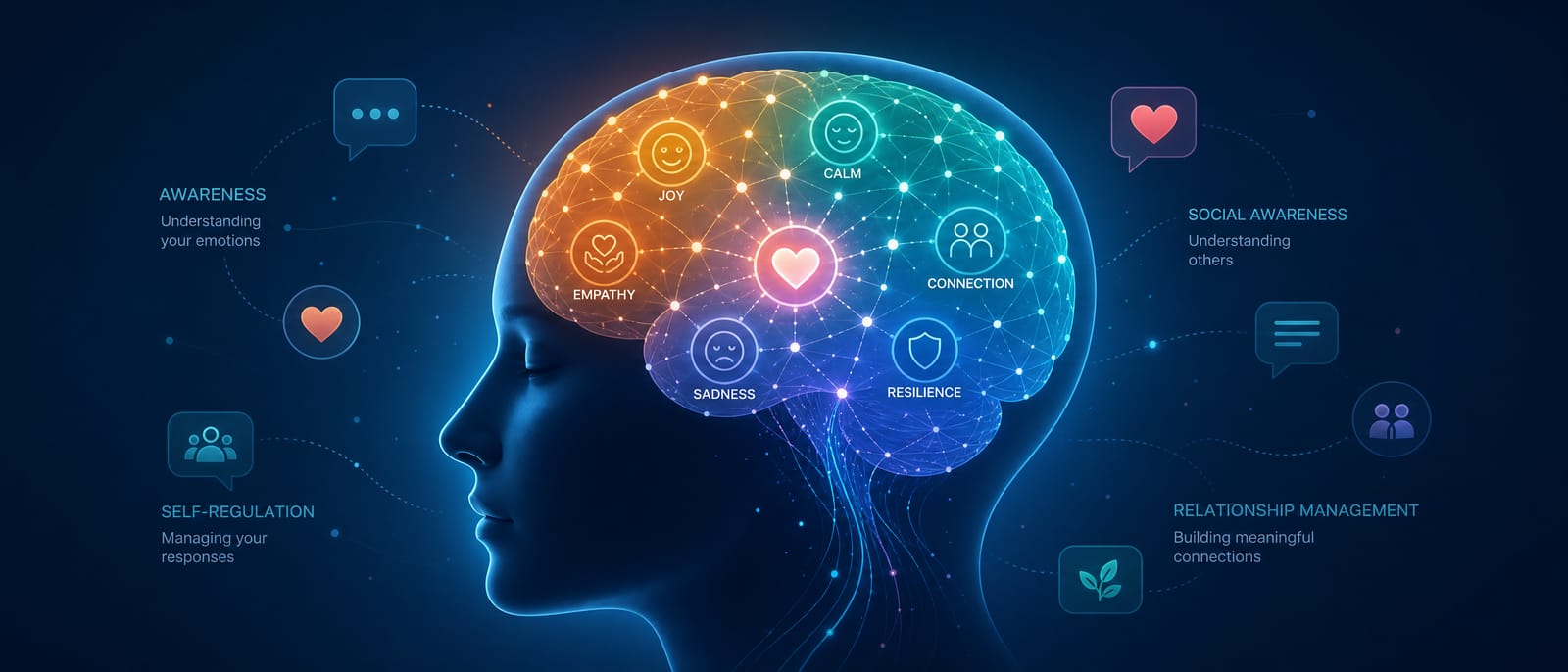
Emotional Intelligence in the Digital Age: How Journaling Rewires Your Social Brain
Bottom line: Digital journaling isn't just a way to record your day; it's a deliberate practice for building the five pillars of emotional intelligence by activating the brain's reflective centers.
In a world where digital interactions often replace face-to-face connection, the ability to understand and manage emotions—both our own and others'—has never been more critical. This set of skills, known as Emotional Intelligence (EQ), is increasingly recognized as a better predictor of life success than IQ [1].
The 5 Pillars of EQ: A Framework for Growth
Psychologist Daniel Goleman popularized the five-pillar model of emotional intelligence: self-awareness, self-regulation, motivation, empathy, and social skills [2]. In our digital lives, these pillars are constantly challenged by rapid-fire notifications, anonymous interactions, and the "always-on" culture.
Without intentional practice, we can become emotionally reactive—quick to interpret a delayed email as rejection, a terse message as hostility, or a curated social feed as evidence of our own inadequacy. Journaling creates a pause between stimulus and response, which is the foundation of self-regulation.
Neuroscience of Self-Awareness: Turning Down the Alarm
The foundation of EQ is self-awareness. When we write about our emotions, we engage in "affect labeling." A landmark 2007 study by Matthew Lieberman at UCLA found that putting feelings into words reduced amygdala activation by up to 50% [3]. By naming an emotion, you move the brain's activity from the reactive emotional center to the reflective prefrontal cortex.
This neural shift is why journaling feels calming even when the subject matter is stressful. You are literally turning down the brain's alarm system and making room for rational, compassionate self-reflection.
Emotional intelligence is not about being "nice" or suppressing your feelings. It's about understanding what you feel, why you feel it, and what to do with that information.
Daniel Goleman, psychologist and author of Emotional Intelligence
The Empathy Gap: Bridging the Digital Divide
Digital communication often lacks the non-verbal cues essential for empathy. Journaling allows us to practice "perspective-taking"—literally writing from another person's point of view to understand their needs and fears [2]. This deliberate exercise helps close the empathy gap created by screen-based interactions.
When you journal about a conflict, you can write not only what was said, but what might have been felt. Over time, this practice strengthens the neural pathways associated with empathy, making you more attuned to others both online and offline.
Journaling for EQ: A Practical Protocol
To build your emotional intelligence, try these research-backed journaling exercises:
- Self-Awareness: What am I feeling right now, and where do I feel it in my body?
- Self-Regulation: What would I do differently with a 10-second pause before reacting?
- Empathy: Think of a recent conflict. Write the other person's perspective as if you were them.
- Motivation: What value am I honoring when I act with patience instead of reactivity?
- Social Skills: Replay a difficult conversation. What could I have said to build connection instead of defensiveness?
Privacy as a Foundation for Authentic Growth
Authentic emotional growth requires a safe space for unfiltered honesty. If you fear your deepest reflections might be seen or analyzed by third parties, you will instinctively self-censor. This is why MindsKeep's end-to-end encryption is essential for emotional intelligence development—it provides the private sanctuary necessary for the brain to engage in deep, honest reflection.
In a digital age that often rewards performance over authenticity, a truly private journal becomes a radical act of self-honesty. And it is from that honesty that genuine emotional intelligence grows.
Try MindsKeep — Free & EncryptedReferences
- Goleman, D. (1995). Emotional Intelligence: Why It Can Matter More Than IQ.
- Chen, D. W. (2026). Journaling for Emotional Intelligence: A 5-Pillar Framework. Life Note Research.
- Lieberman, M. D., et al. (2007). Putting feelings into words: Affect labeling disrupts amygdala reactivity. Psychological Science.